Originally published in Facility Managers Journal, the official publication of the International Facility Management Association (IFMA). Reprinted with permission.
Mold growth inside exterior wall assemblies remains one of the most costly and difficult indoor environmental challenges for facility managers. Often hidden from view, moisture accumulation within wall cavities can persist for months before visible damage or occupant complaints appear. By the time staining, odors, or health concerns emerge, remediation costs and liability risks are already rising.
In many cases, the underlying cause is not simply elevated indoor humidity, but uncontrolled airflow. When a building operates under negative pressure, humid outdoor air is continuously drawn into the building envelope. As this air cools within wall assemblies, condensation forms, providing the moisture needed to support microbial growth. Over time, this hidden moisture reservoir can compromise indoor air quality (IAQ), building materials, and occupant health.
Mold requires moisture to grow, but it rarely obtains that moisture directly from indoor air. Instead, it relies on building materials—such as gypsum board, insulation facings, wood, concrete, and dust—that absorb and retain water. Moisture enters these materials through surface condensation, interstitial condensation within porous components, or wicking from damp surfaces.
A common misconception is that maintaining indoor relative humidity below 60 percent is sufficient to prevent mold. Surface temperatures vary throughout a building. Exterior walls, thermal bridges, and poorly insulated areas are often cooler than the surrounding air. As a result, the relative humidity at these surfaces can be significantly higher than measured room values. If humid air reaches these cooler areas and falls below its dew point, condensation will occur even when space humidity appears acceptable.
ASHRAE Standard 62.1 reinforces this concept by emphasizing the control of moisture through both humidity and dew point limits, particularly at system cooling coils and supply air conditions. The standard recognizes that managing moisture is not solely about space relative humidity, but about preventing conditions where condensation can occur within building assemblies or on surfaces.
Once moisture is trapped inside a wall cavity, it can sustain mold growth long after ambient conditions have changed..
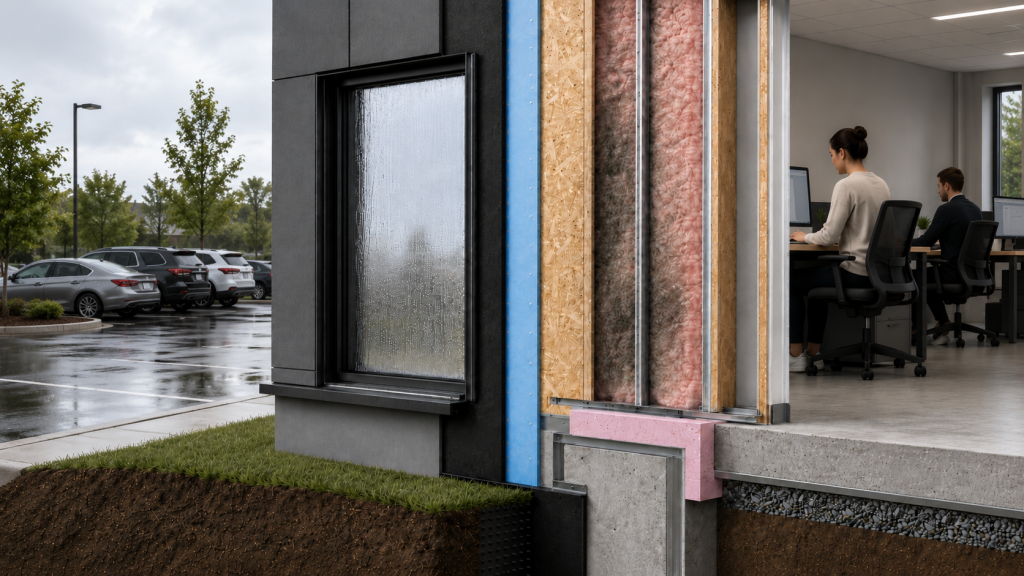
One of the most effective ways to limit moisture intrusion is to maintain continuous, slight positive pressure relative to outdoors. When more air is supplied to a building than is exhausted, a positive “pressurization flow” is created. This outward airflow reduces infiltration through cracks and openings in the building envelope.
Positive pressurization is especially critical in humid climates and during shoulder seasons, when outdoor moisture levels remain high. Unfortunately, many buildings operate negatively during unoccupied hours when ventilation systems are shut down or reduced. These off-hours periods often coincide with cooling surfaces and high humidity—ideal conditions for condensation inside walls.
Maintaining positive pressure should therefore be viewed as a continuous operational strategy, not merely a commissioning target.
Limitations of Conventional Control Strategies
Many HVAC control sequences were developed primarily to minimize first cost and energy use. While well-intentioned, these approaches often fail to maintain stable pressurization in real-world conditions.
Fixed outdoor air dampers are common in supply-fan-only systems. However, wind, stack effect, and variable air volume (VAV) operation cause actual outdoor airflow to fluctuate widely, leading to unpredictable pressure relationships.
Proportional fan tracking using variable frequency drives assumes that supply and return fans will maintain airflow balance by running at similar speeds. In practice, changing system resistance and economizer operation make this approach unreliable.
Static pressure control of return fans attempts to maintain building pressure directly. However, very low differential pressure setpoints are difficult to measure accurately and are highly sensitive to wind effects and sensor placement.
All of these methods rely on indirect indicators of airflow. As a result, buildings may drift negatively even when control systems appear to be functioning properly.
A more robust strategy focuses on directly measuring and controlling the airflow rates that determine pressurization. Pressurization flow is simply the difference between air entering and leaving the building. If that differential remains positive, the building tends to remain positively pressurized.
For supply-fan-only systems, this requires accurate measurement and control of outdoor air intake, often coordinated with return air damper modulation.
For systems with return or relief fans, maintaining a controlled volumetric difference between intake and exhaust airflows provides stable pressure control. In some configurations, maintaining a small continuous “bleed” through relief dampers improves stability across operating modes.
Direct airflow measurement allows facility teams to verify performance, identify deviations, and correlate pressure problems with weather conditions, schedules, or equipment modes.
To reduce moisture-related risks in exterior walls, facility managers should consider the following best practices:
Treat pressurization as an ongoing operational requirement, not a one-time balancing task.
Maintain slight positive pressure during occupied and unoccupied periods, particularly in humid seasons.
Be cautious of control strategies based solely on damper position, fan speed, or static pressure.
Where feasible, implement airflow measurement and control sequences that directly support pressurization objectives.
Trend and review airflow and operating data to detect drift, equipment faults, or seasonal impacts.
Preventing mold inside exterior walls starts with controlling airflow direction. When buildings operate under negative pressure, humid air is drawn into the envelope and condenses on cool surfaces. By maintaining continuous positive pressurization through measured, dynamic ventilation control, facility managers can significantly reduce hidden moisture accumulation, improve IAQ, and limit long-term operational and liability risks.
Effective pressurization control supports healthier buildings, protects building assets, and provides a measurable foundation for sustainable facility management.
© 2023, EBTRON, Inc.