Every second counts in a data center, where stability and redundancy define success. EBTRON airflow measurement solutions deliver continuous, accurate data that engineers and facility managers can rely on to ensure balanced cooling, proper pressurization, and dependable system response — providing the foundation for efficient and reliable data center operation.
Data centers depend on precise airflow to maintain temperature, pressurization, and redundancy — yet in many facilities, this airflow is assumed rather than measured. Without verified airflow data, cooling systems operate blindly, masking inefficiencies that drive up energy use, increase cooling demand, and threaten uptime.
Power Usage Effectiveness (PUE) is the benchmark for data center efficiency, comparing total facility energy to the power consumed by IT equipment. While leading facilities approach a PUE of 1.6, most operate between 2.4 and 3.0, meaning as much as 65% of total energy is consumed by cooling and support systems. Uneven airflow, bypass air, and recirculation are major contributors — all symptoms of poor airflow distribution and control that can’t be managed without measurement.

Beyond energy waste, unstable airflow undermines redundancy and control. Fan walls, containment systems, and underfloor plenums depend on stable pressure relationships to maintain correct airflow direction and distribution. Small changes in pressure can shift airflow paths, disrupt containment, or destabilize control. Without continuous, accurate feedback, airflow behavior can’t be verified or maintained — leaving both design intent and operational efficiency uncertain.
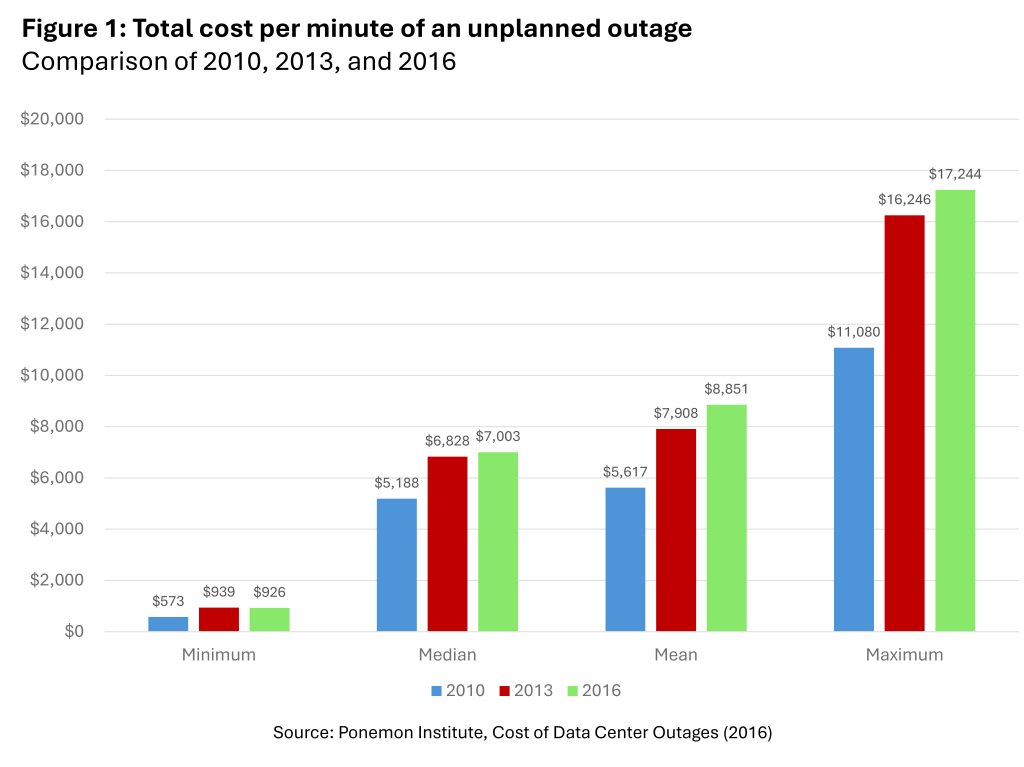
As airflow control becomes unstable, system reliability begins to slip — and downtime quickly becomes the most expensive consequence. Thermal excursions or unplanned shutdowns can cost thousands of dollars per minute (Figure 1), quickly eclipsing any energy savings achieved through efficiency improvements. The true cost of airflow imbalance isn’t just higher PUE — it’s the risk of lost uptime, damaged equipment, and reduced customer confidence.
To achieve lasting efficiency and uptime, data centers need visibility — real, repeatable airflow and temperature data at every critical point: supply, return, containment barrier, and underfloor plenum. Reliable measurement is the foundation for stable control predictable response, and long-term performance. With continuous accurate feedback, airflow systems can adapt to changing load conditions, maintain redundancy, and safeguard uptime.
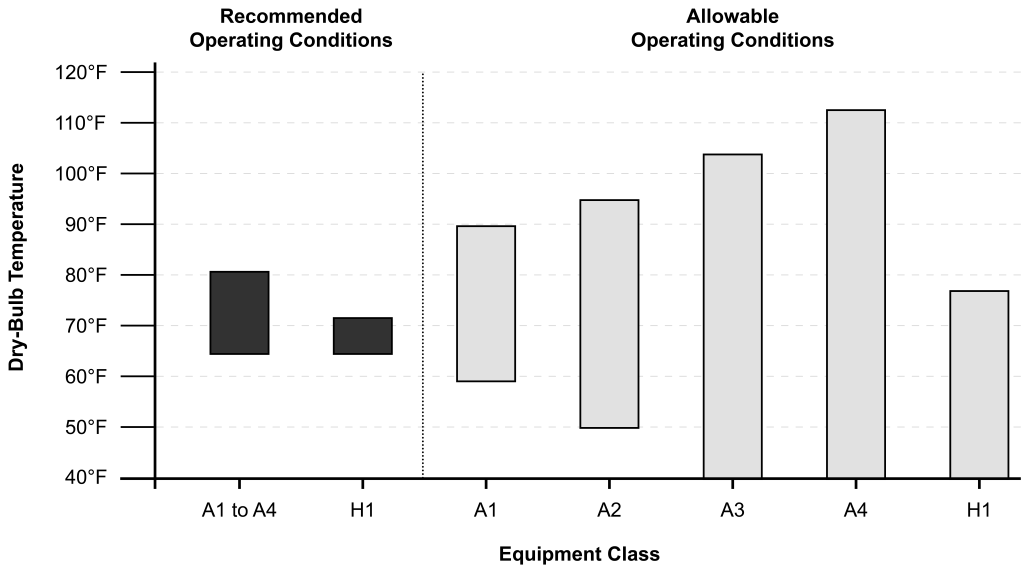
ASHRAE Thermal Guidelines define recommended and allowable operating conditions for IT equipment based on server inlet temperature and humidity. Temperature alone, however, is a lagging indicator. A rise in inlet temperature signals that airflow delivery may have already degraded due to imbalance, bypass, recirculation, or load change.
Accurate airflow measurement provides the missing control variable required to reliably operate within these guidelines. By measuring actual airflow delivery, data centers can:
Every data center operates as a dynamic airflow network — supply, return, containment, and pressurization systems must work in harmony to maintain stable temperature and redundancy. Accurate measurement of these key variables enables engineers and facility managers to optimize airflow performance and control strategies, maintain long-term reliability, and detect issues before they impact uptime or efficiency.
Hot Aisle Containment (HAC) and Cold Aisle Containment (CAC) are common airflow management strategies used to separate supply and return air streams in data centers. Server racks are arranged in alternating rows — with cold air intakes facing one direction and hot exhausts facing the other. The containment structure isolates the two aisles to minimize mixing, improve cooling efficiency, and maintain uniform inlet temperatures across racks. Proper containment improves temperature control, allows higher supply air setpoints, and supports lower fan energy use compared to uncontained configurations.
Containment performance depends on maintaining correct airflow direction and small, stable pressure differentials. When these shift, hot exhaust can leak into the cold aisle or conditioned air can bypass the racks, reducing ΔT and cooling efficiency. Static pressure sensors can’t reliably detect these low-velocity, bi-directional changes — leaving airflow imbalances unseen until performance is affected.
The Solution:
EBTRON bi-directional “bleed” sensors directly measure airflow magnitude and direction across containment barriers, providing real-time feedback for pressurization control. Paired with supply and return airflow sensors, they verify separation between aisles, confirm airflow balance, and help maintain predictable cooling performance across load conditions.
Fan wall and distributed cooling systems use multiple, smaller fans arranged in parallel along the perimeter of the data hall or within cooling units to deliver conditioned air directly into the white space. This configuration enhances redundancy, control, and energy efficiency compared to single large fans. Each fan’s airflow contribution must remain balanced to maintain uniform air distribution, prevent hot spots, and support stable pressure relationships across containment zones.
Airflow imbalance among fan wall modules can compromise cooling performance, energy efficiency, and redundancy in N+1 or 2N configurations. If one fan fails or operates at a different speed, air distribution across the data hall becomes uneven—causing thermal hotspots, unstable containment pressure, and inefficient fan operation. Traditional feedback from fan speed or static pressure sensors cannot verify true airflow uniformity across the array, making it difficult to confirm total system delivery or detect degraded fan performance.
The Solution:
EBTRON thermal dispersion sensors are installed on each fan within the array, providing direct velocity measurement at every fan outlet. This per-fan monitoring ensures uniform performance, detects imbalances immediately, and verifies redundancy across distributed fan systems. By measuring actual airflow instead of inferring it from fan speed, data from EBTRON sensors enable precise fan tracking, optimized sequencing, and confirmation that total system airflow meets design intent. When integrated with return and outdoor airflow sensors, EBTRON delivers continuous verification of system balance and energy efficiency.
Many data centers use airside economizers to reduce mechanical cooling by introducing outdoor air when ambient conditions permit. During economizer operation, outdoor air mixes with return air to maintain target supply temperature and humidity while minimizing compressor energy use. Accurate outdoor airflow measurement is essential to maximize free-cooling hours, maintain pressurization, and ensure proper ventilation to support spaces and occupied areas.
Outdoor airflow is influenced by wind pressure, damper position, and other environmental and mechanical equipment effects, making it difficult to regulate based on static pressure or damper feedback alone. Without accurate measurement, economizer systems can experience unstable pressurization, inefficient mixing, or wasted energy from over-ventilation.
The Solution:
EBTRON thermal dispersion sensors directly measure the velocity, temperature, and psychrometric properties of the airstream entering the economizer or ventilation intake—independent of wind, density, or damper position fluctuations. This enables precise economizer control and enthalpy-based operation. When integrated with supply and return airflow data, EBTRON sensors maintain consistent pressurization, verify ventilation balance, and provide real-time confirmation of free-cooling performance and energy code compliance.
Overhead air distribution systems deliver conditioned air from CRAH units or fan wall plenums through ductwork or ceiling-mounted diffusers directly into the cold aisles. These systems are often used in slab-on-grade data centers or facilities without raised floors. Proper airflow balance and temperature control are essential to avoid stratification and maintain consistent inlet temperatures across rack heights.
Overhead systems are more susceptible to thermal stratification and uneven airflow delivery due to varying ceiling heights, diffuser layouts, and load conditions. Without direct airflow measurement, fan speed control and economizer operation rely on assumptions about duct pressure or temperature that may not represent actual system behavior.
The Solution:
EBTRON thermal dispersion sensors provide direct measurement of airflow and temperature at CRAH outlets, fan walls, or supply ducts feeding cold aisles. These sensors quantify true airflow rates, enabling precise fan control and verification of balanced air delivery to each zone. When paired with return airflow and temperature sensors, they allow continuous tracking of ΔT and system efficiency, supporting economizer control and stable rack inlet conditions.
Underfloor Air Distribution (UFAD) systems use a raised-floor plenum to deliver conditioned air from CRAC or CRAH units into cold aisles through perforated tiles or floor grates. The plenum functions as both an air delivery and pressure equalization chamber, providing low-velocity, evenly distributed airflow to IT racks. Maintaining stable underfloor pressure is critical to ensure consistent air delivery across the entire floor area.
Pressure within the plenum can fluctuate due to load variations, tile configuration, or supply fan changes. Low plenum pressure limits cooling at distant racks, while excessive pressure causes over-delivery or bypass airflow near supply tiles. Conventional static pressure sensors cannot detect airflow direction or accurately quantify true flow through underfloor openings, making precise control difficult.
The Solution:
EBTRON bi-directional “bleed” sensors provide direct measurement of both airflow magnitude and direction within underfloor plenums or bleed paths. This allows operators to verify plenum pressurization, detect flow reversal, and maintain uniform air delivery across the raised floor. Unlike static pressure sensors that infer airflow, EBTRON devices measure true velocity, providing real-time visibility into system behavior. When integrated with supply and return airflow measurement, EBTRON solutions deliver complete feedback for balanced ΔT, optimized cooling efficiency, and reliable fan control.
EBTRON airflow measurement systems are installed in hundreds of mission-critical data centers worldwide — providing engineers and operators with the data required for reliable cooling performance and system stability.
© 2023, EBTRON, Inc.