The control of building pressure is essential to maintain acceptable indoor air quality (IAQ), thermal comfort and structural integrity. Negatively pressurized buildings result in the transport of untreated outdoor air into the building. This untreated outdoor air will result in:
In addition, improper building pressure may:
Understanding Building Pressure
The term building “pressure” is somewhat of a misnomer. Building pressure is the result of a differential airflow
created by the mechanical system across a pressure barrier. It is often referred to as the “pressurization airflow”.
Although the pressurization airflow will result in a measurable pressure drop across interior and exterior walls, static
“pressure” control of building pressure will not ensure proper building pressurization.
Problems with Static Pressure Control
Static pressure control has been widely implemented as a technique to control building pressure. In most
applications, a low cost differential pressure sensor is connected between the exterior of a building and an internal
reference position within the pressure zone. These sensors are subject to both short and long‐term drift, are
affected by ambient temperature and have questionable accuracy at the low pressures required for proper building
pressurization. Depending on the strategy used, either a return or relief/exhaust fan or damper is modulated to
maintain the differential between the reference position and building exterior. Unfortunately, the differential
pressure measured will typically NOT represent the actual net building pressure because of:
In addition, static pressure control is extremely problematic in systems with multiple pressure zones or air handling units because of pressure interaction. One fan system will influence the operation of another fan system.
Stability is also affected by transient wind gusts, door open/close events (interior and exterior) and pressure sensor
stability.
In reality, the only time that static pressure represents net building pressure is when there is no wind on the building
and all of the interior doors in a pressure zone are open.
Implementing a Sound Building Pressurization Strategy
Step 1: Analyze internal building pressure zone requirements
Analyze the pressure requirements of the building and compartmentalize the building into multiple pressure zones
when applicable. Multiple pressure zones may be dictated by space use requirements. Examples of spaces that may
require multiple pressure compartments, include:
Step 2: Consider external factors
Pressure zones may be dictated by external environmental factors outside of the building, such as the pressure
variations created by stack pressure on multi‐story buildings. An open return air duct is essentially a large “hole” in the building when an air handling system is used to provide air to multiple floors.
Step 3: Measure and control the pressurization airflow
The pressurization airflow can only be created by a mechanical system. Wind pressure, for example, cannot
pressurize a building. It can only locally pressurize surfaces of the building; the net pressurization result as a building as a whole being zero.
In a simple single pressure compartment building system, the pressure compartment boundaries are the exterior
walls and roof.
The mechanical airflow differential of concern is the outside air and exhaust airflow differential.
The relationship between differential airflow (not building static pressure) and IAQ is clearly stated by ASHRAE
Standard 62.1‐2019, with approved addenda.
5.11 Building Exfiltration. Ventilation system(s) for a building shall be designed to ensure that the
total building outdoor air intake equals or exceeds the total building exhaust under all load and dynamic reset conditions.
Informative Note: Although individual zones within a building may be neutral or negative
with respect to outdoors or to other zones, net positive mechanical intake airflow for the
building as a whole reduces infiltration of untreated outdoor air.
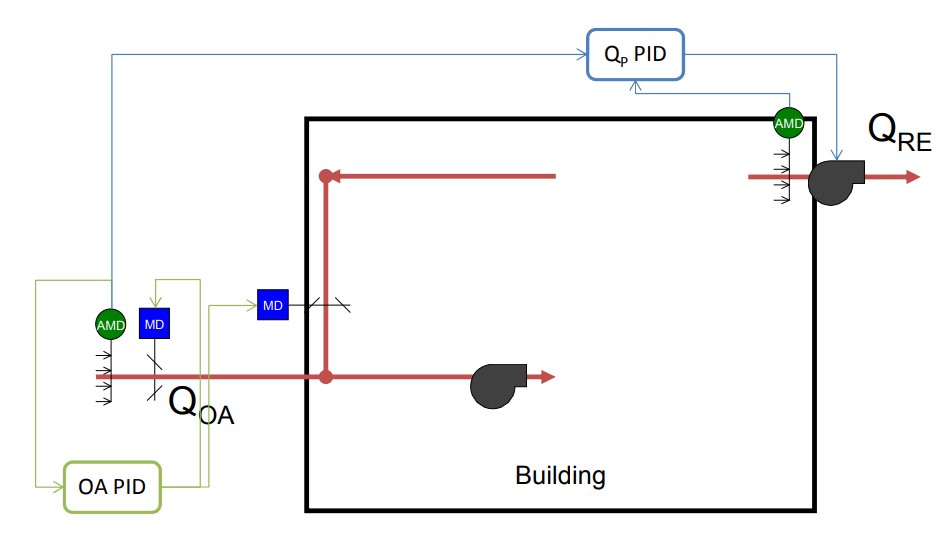
Building mechanical systems that use supply fan air handling units with a separate relief or exhaust fan in each
pressure zone can often control building pressure effectively by maintaining the airflow differential between the
outside air intake and relief/exhaust fan.
A simplified control schematic and sequence of operations are shown in Figure 1.
Figure 1 – SUPPLY AIR FAN SYSTEM WITH SEPARATE RELIEF/EXHAUST FAN
Building mechanical systems that use air handlers with integral return or relief air fans often present a challenge
for the proper application of an airflow measuring device in the relief air path. As a result, a different location
for measurement is often required to determine the airflow differential required for pressurization.
Fortunately, the challenge is easily resolved. Figure 2 demonstrates that the mathematical equivalent of QOA‐QRE IS QSA‐QRA.
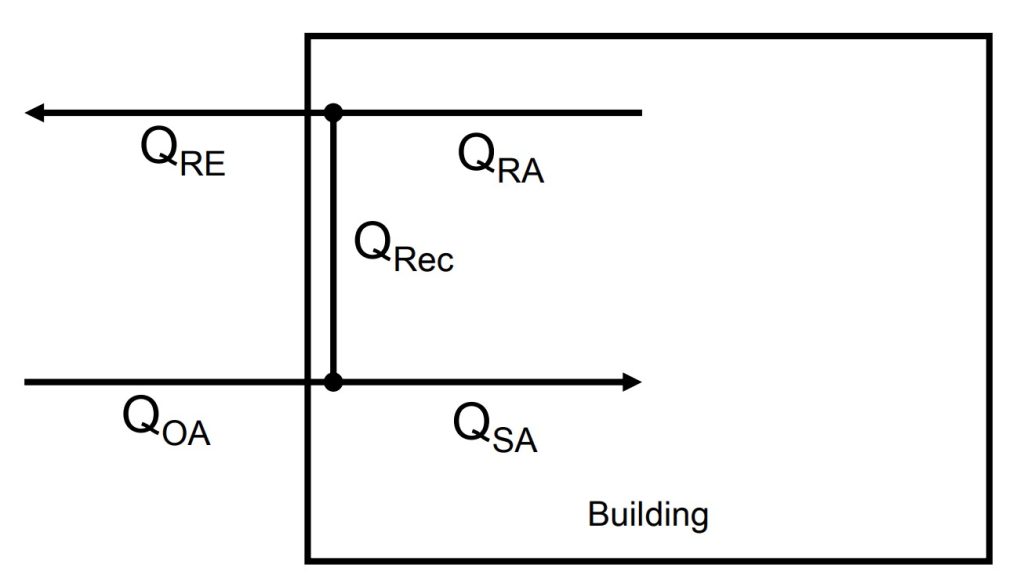
It is important to recognize that since the airflow differential between the supply and return air paths of each air handling system is essentially the pressurization airflow for the building, the control of supply and return (or relief) fans are crucial to proper building pressurization. Systems that trivialize the importance of this differential and use either variable speed fan drive, slaving, or low accuracy airflow measurement devices for fan tracking will have serious pressure control problems when air is being relieved at the air handler.
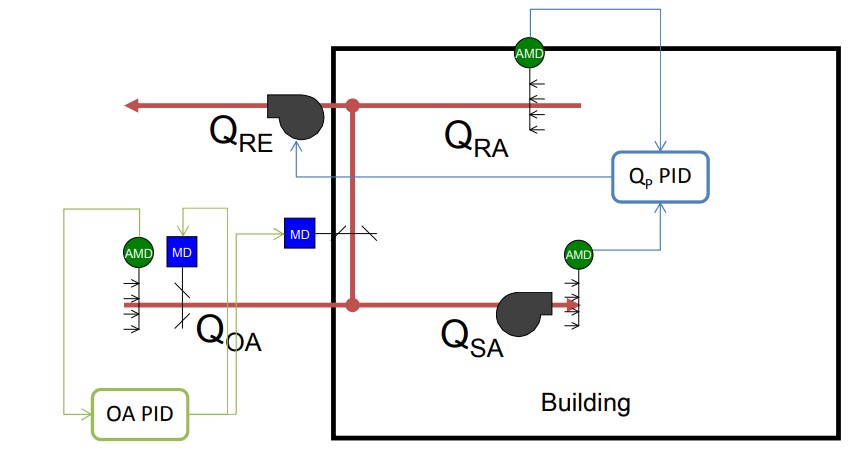
The preferred building pressure control strategy for supply/return and supply/relief air handling systems is shown in Figures 3 and 4.
Figure 3 – SUPPLY AIR FAN SYSTEM WITH INTEGRAL RETURN AIR FAN

Figure 4 – SUPPLY AIR FAN SYSTEM WITH INTEGRAL RELIEF AIR FAN
In more complex building systems where a single air handling system serves multiple pressure zones, controlling the supply and return (or exhaust) differential into each pressure zone will result in compartmentalized pressurization without unwanted interaction.
Determining the Pressurization Airflow Required
Typically, the objective of building pressurization is to maintain a slight positive pressurization airflow. A rule of
thumb is to provide between 0.03 and 0.05 CFM of pressurization airflow per square foot of floor area. In reality, the pressurization air is more a function of the building envelope construction, door/window seals and ceiling height. However, this rule of thumb is applicable to many buildings.
The pressurization airflow can also be estimated using computer models of the building envelope and openings.
Perhaps the best way to determine the pressurization airflow is in the field. There are two methods currently
being developed by EBTRON. Note that on multi‐story buildings these techniques should be done on each floor to
compensate for stack effect.
Method 1: Use installed airflow measuring devices to slightly over‐pressurize the building. This technique is similar to that employed in envelope leakage studies. A larger than desired pressure (but less than that which would damage the envelope or roof) is created with the mechanical system and the pressure between a reference position inside of the building and an external reference is measured with all interior doors in the pressure zone open. This can be done with a good quality portable pressure sensor. A larger pressure is selected to minimize wind effect. The pressurization airflow is then extrapolated from the test data for the net pressure desired in the absence of wind and with all interior doors open (i.e. the pressurization flow required for the net pressure desired with no wind and no airflow pressure losses under closed doors).
Method 2: Use portable pressure sensors on all exterior surfaces of the building to obtain the average exterior pressure that results from wind velocity being converted to static pressure. Open all interior doors
to eliminate pressure drop from flow paths under closed doors. Use the average pressure to set the airflow differential desired.
Airflow Measurement Performance: A Prerequisite for Proper Pressure Control
Determining the pressurization airflow requires an accurate measurement of a relatively small airflow differential. As a result, airflow measurement accuracy is critical and in most cases must be equal or better than 3% of reading. Airflow measurement devices with lesser accuracies cannot assure proper net building pressurization and air balance professionals can rarely adjust these devices to achieve accuracies better than 5 to 10% of reading in the field. In addition, percent of reading accuracy is required over the entire operating airflow range to ensure pressurization on VAV systems or any system with a modulating airside economizer. As with any sound control strategy, long term instrument performance with negligible drift is also a prerequisite for success.
The bottom line is that the proper selection, application, and installation of airflow measuring devices is critical for
proper building pressure control.
Conclusions
Building pressure control is essential to IAQ, thermal comfort, structural integrity and the energy footprint of a building. Building pressure is achieved by maintaining a net pressurization airflow. Static pressure control techniques may appear to achieve desired pressure objectives but in reality, can result in false readings because of wind pressure, internal pressure variations and sensor drift.
Buildings should be compartmentalized into unique pressurization zones based on space use and external pressure variations, such as stack effect. High-performance airflow measurement devices should be used to maintain the building pressurization airflow. Measurement locations are dependent on HVAC system design.
© 2023, EBTRON, Inc.